




 Top


The trends we observed in the 2025 proxy season continued to unfold in 2026: the Securities and Exchange Commission (SEC) stepped back from reviewing whether companies could exclude shareholder proposals, while large investors and proxy advisers offered different voting policies for different clients. On the ballot itself, the proposal mix continued shifting toward governance and away from environmental and social (E&S) topics, while artificial intelligence (AI) emerged as a fast-growing area of shareholder focus
Against this backdrop, Calvert's proxy guidelines—rooted in the Calvert Principles for Responsible Investing (Calvert Principles)—enabled us to apply consistent standards to every proxy vote, in alignment with long-term financial and sustainability outcomes rather than shifting market trends.
Key 2026 Proxy Voting Trends
The SEC's Reduced Role on Shareholder Proposals
The most consequential development of the season was regulatory. In November 2025, the SEC's Division of Corporation Finance announced that, for the 2025–26 proxy season, it would suspend substantive responses to most no-action requests, citing resource and timing pressures following the government shutdown. Rather than granting substantive no-action relief, it would issue an automatic “no objection” response based on a company's own representation that it has a reasonable basis to exclude. The staff carved out one exception, agreeing to continue responding substantively to exclusion requests under Rule 14a-8(i)(1), which covers proposals that are not a proper subject for shareholder action under the laws of the company's state of organization, though as of August 2026, no company had sought exclusion on that basis. Although framed as a temporary, season-specific measure, the practical effect is a structural shift in how proposals reach the ballot. The near-term effects were measured—roughly 22% of known proposals were omitted, broadly comparable to the prior year—but the uncertainty is now structural, with Rule 14a-8 amendments on the SEC's rulemaking agenda and at least six companies already sued over exclusions.1
We saw the challenges associated with this discretion firsthand. On one engagement call, a company defended excluding a proposal on the grounds that it did not receive majority support the previous year, which is common for most first-time proposals, but not necessarily grounds for exclusion. In another case, a company facing two resolutions on the same topic excluded the less onerous version, leaving shareholders to vote on the more demanding one, making rejection of the resolution more likely. Where we believed proposals were improperly omitted, Calvert engaged directly and, when a company’s rationale was unpersuasive, voted against members of the governance committee or other relevant directors to signal that we viewed the exclusion as inappropriate.
Calvert engaged companies that excluded shareholder proposals and voted against certain directors where we believed exclusions were misused.
A More Fragmented Stewardship Landscape
The two primary investor stewardship tools, proxy voting and corporate engagement, have taken different paths among investors.
Large institutional investors and proxy advisers increasingly offer a range of voting policies to serve different clients. A diversity of independent voices in the market can be constructive; however, the greater challenge arises when a single investor or adviser applies multiple policies, making the expectations communicated to any given company less clear. Separately, several managers reduced their reliance on proxy advisers, with some building internal voting capabilities, while proxy advisers faced congressional, regulatory, and legal scrutiny. Glass Lewis, a leading global proxy advisory firm, said it would phase out its “benchmark” voting policies by 2027, which we attribute in part to that pressure.2
In January 2026, Calvert brought its proxy-voting execution in-house, moving away from customized voting recommendations provided by an external proxy adviser to a process supported by a dedicated team of internal analysts.
The team provides vote recommendations to Calvert’s proxy team through a proprietary voting platform, applying Calvert’s established voting policy. This approach gives us greater control over implementation while preserving a single, consistent voting framework.
Through this process, we have intentionally maintained a clear and unified approach so that the expectations we communicate to companies are not diluted by competing policy signals. This enables us to evaluate proposals on a case-by-case basis within a consistent, principles-based framework. As stewardship practices become more fragmented across the market, we believe that clarity, consistency, and direct engagement will become increasingly important.
Consistency also matters beyond the vote itself. Throughout the year, Calvert engaged companies directly to communicate expectations, discuss emerging risks, and evaluate how boards are addressing financially material governance, environmental, and social issues. By pairing active ownership with a unified voting framework, we sought to reinforce a clear and credible stewardship signal.
Calvert maintained a single, unified voting framework and brought proxy-voting execution in-house to reinforce a clear and consistent stewardship signal.
Governance Proposals Rise as E&S Proposals Fall
Continuing the trend from 2025, proponents leaned into core governance topics—principally shareholder rights (such as written consent, special meeting thresholds, and simple-majority voting), board composition (including independent chair), and executive compensation, while E&S proposals declined. Governance proposals rose roughly 30% to 322, yet support fell sharply, averaging about 29%, down from roughly 40% in 2025. Environmental and social proposals declined to 98 (a 30% decline) and 179 (a 42% decline) respectively.3 This divergence may suggest that some proponents are redirecting efforts toward governance-focused proposals, which have generally faced fewer political and regulatory headwinds (meaning they will likely lead to fewer exclusions), and continue to resonate with investors as matters of board accountability and shareholder rights.
Two dynamics stand out. Proposals that are critical of, or question the value of company policies or initiatives related to environmental and social factors have increased and now account for a more significant share of total shareholder proposals. As of the end of May 2026, 38% of total shareholder proposals fall into this category. However, in 2026, the votes in favor of such proposals only averaged about 1.7%.2 Although fewer environmental and social proposals were filed, average support for those that reached a vote ticked up slightly year over year. In our view, this reflects a smaller, more focused set of proposals: those that survive the filing and exclusion process are increasingly ones tied to financially material risks, which in turn attract broader investor support at the ballot.
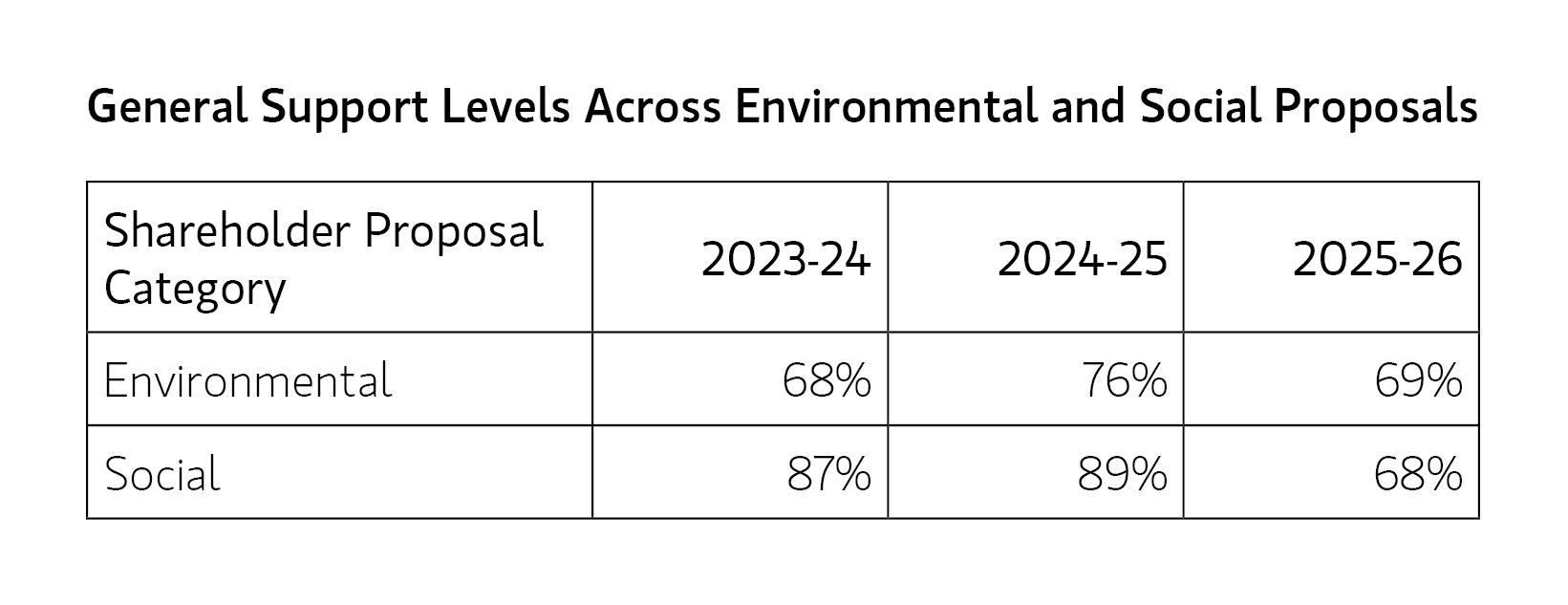
Globally, Calvert supported 69% of environmental and 68% of social proposals in 2026, and 60% of governance proposals, consistent with prior years.
The Rise of AI-Related Proposals
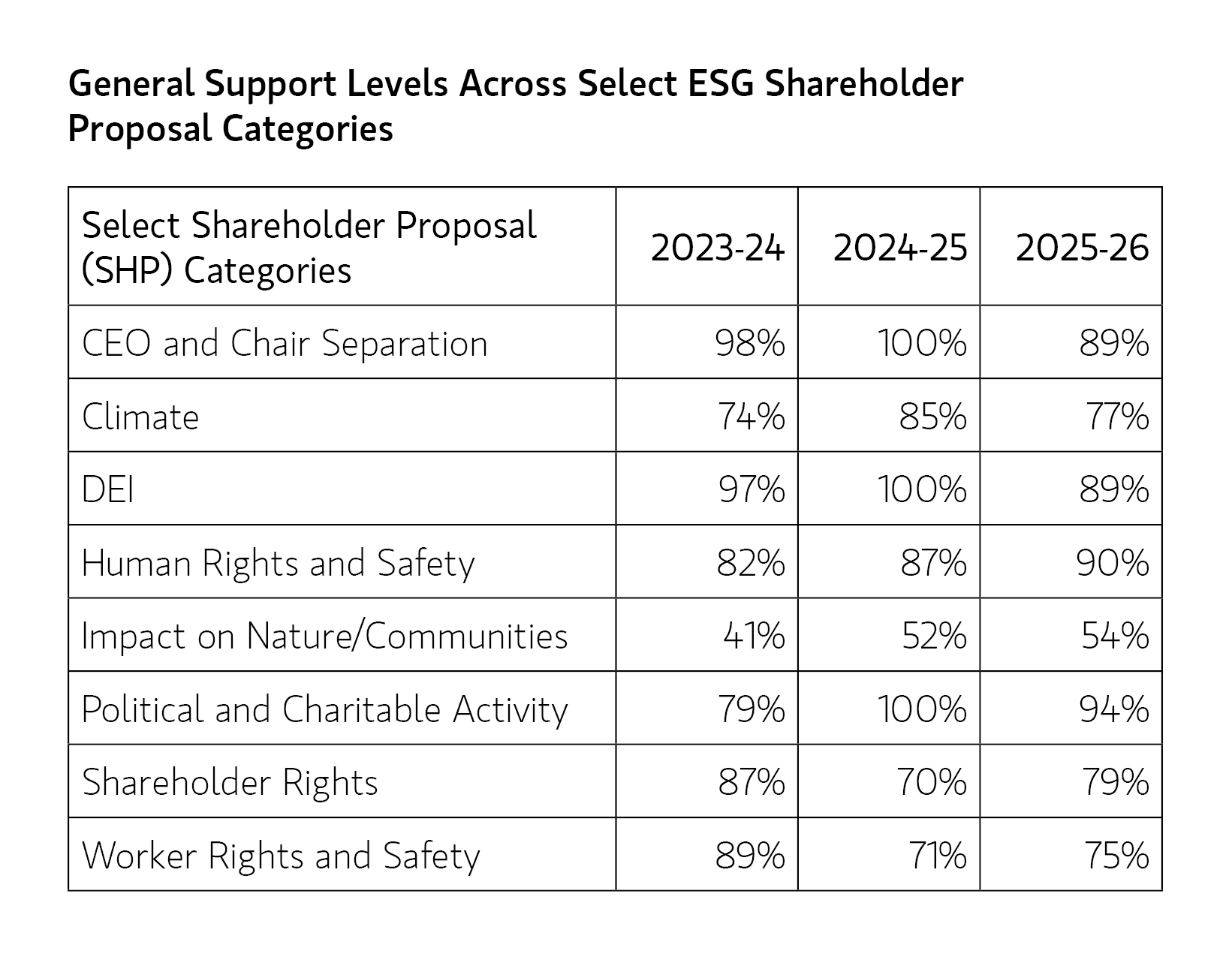
AI-related proposals took several forms in 2026, including new requests addressing the greenhouse-gas and water impacts of AI and data centers, as well as recurring proposals on board oversight and the sourcing of training data. AI-related proposals received an average support of 7.4% (ranging from 1.2-22.5% support), which is common for first-time proposals, but several attracted meaningfully higher support, suggesting investor interest in the topic in at least some cases. These include a water-usage proposal at Digital Realty Trust, which received about 22.5% support and an emissions proposal at Amazon, which received about 18.4%. Calvert evaluates AI-related proposals through the same materiality lens we apply elsewhere, supporting those that strengthen governance, transparency, and board oversight of AI-related risks. Those risks span both the social dimensions of AI—bias, privacy, content integrity, and training-data governance—and its environmental footprint, including the energy, emissions, and water demands of data centers. We supported both proposals cited above on that basis.
Calvert continued to support AI-related proposals that sought stronger governance, transparency, and oversight of material risks, including the water-usage and emissions proposals at Digital Realty Trust and Amazon. In all, Calvert supported 73% of AI-related proposals.
Ongoing Regulatory Change
The regulatory backdrop continued to evolve during this year’s proxy season—spanning litigation, actions by state attorneys general, federal enforcement, and proposed rollbacks such as the SEC's move to rescind its climate-disclosure rules. The effects were sharpest on diversity practices: S&P 500 board-diversity consideration policies fell from 58% of companies in 2025 to just 12% in early 2026, and explicit diversity-and-inclusion references were largely removed from large-cap disclosures.2 Public EEO-1 workforce reporting—which Calvert has long engaged companies to encourage—now faces growing uncertainty, even as regulatory regimes outside the U.S., such as the EU's Corporate Sustainability Reporting Directive, continue to treat workforce diversity as material.
Again here, Calvert remains steadfast in its approach in evaluating board and workforce diversity and applies the Calvert Principles’ expectation that companies foster equitable and diverse workplaces, which we translate into specific gender and ethnic/racial diversity standards for the U.S. and other markets where disclosure is sufficiently comparable. In the U.S., Calvert continues to call for S&P 500 companies to publicly disclose their EEO-1 reports. Calvert's approach has not shifted: we assess each proposal on financial materiality and long-term value, because we believe diverse workforces and leadership drive productivity and performance.
Calvert supported 89% of diversity- and inclusion-related proposals this season.
Calvert's 2026 Voting Record
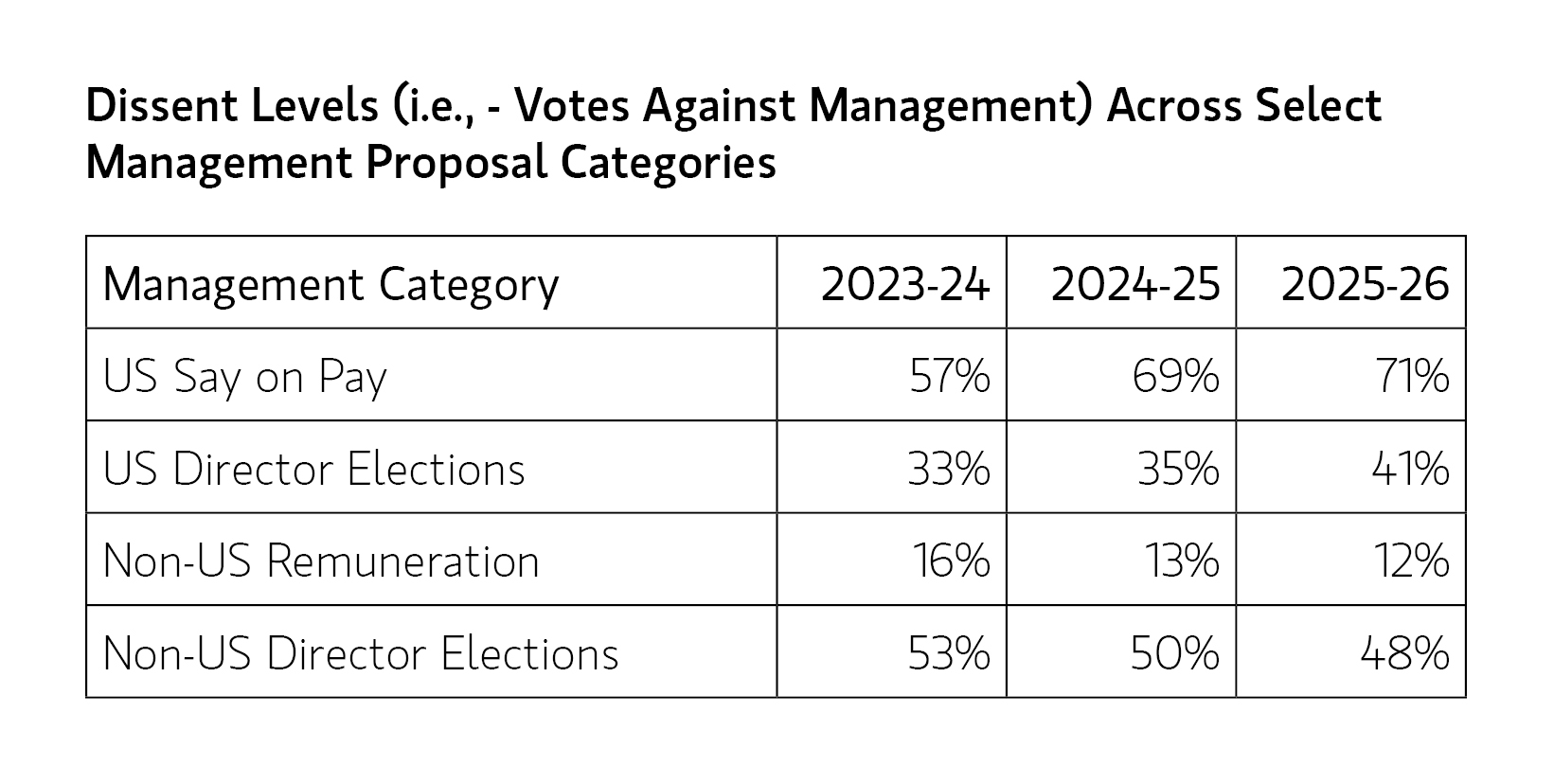
Calvert has remained committed in its strong support of E&S proposals it believes are financially material and has voted against management where warranted under our proxy voting guidelines.
Voting represents only one component of our stewardship approach. Our proxy decisions are informed by ongoing dialogue with companies, allowing us to better understand governance practices, communicate investor expectations, and assess progress on material issues over time.
Our consistency is also evident in recurring proposals: for example, Calvert supported similar AI and human-rights proposals at large technology companies across multiple proxy seasons.
Case Study: At Alphabet, Calvert supported a shareholder proposal in both 2025 and 2026 requesting enhanced disclosure of the risks associated with the use of external data in the development, training, and deployment of the company's AI systems. The proposal sought greater transparency around training-data governance, privacy protections, intellectual property considerations, and broader AI-related risks. Calvert's consistent support across both years reflected our view that robust oversight of AI development is increasingly important given the widespread use of Google's products and ongoing concerns regarding data governance and consumer privacy. By supporting the proposal, Calvert underscored the importance of transparency and accountability in the responsible development and use of artificial intelligence.
Outside the U.S., where shareholder-proposal support is generally lower, we continued to support proposals that were relevant, achievable, and aligned with long-term shareholder value.
The tables below show the percentage of shareholder proposals in each category that Calvert voted in favor of, by proxy year. Percentages cover global meetings (U.S. and non-U.S. combined) and are calculated as votes in favor divided by all proposals voted in that category.
On U.S. Say-on-Pay, we maintained our approach requiring long-term incentive awards to include a balanced mix of time- and performance-based awards, which we introduced ahead of the 2025 proxy season. This approach accounted for most of our votes against Say-on-Pay resolutions, while market-wide support remained in the low 90% range.3 Further detail is available in our Global Proxy Voting Guidelines.
Looking Ahead: Consistency, Accountability, and Engagement
Looking ahead to 2027, we expect many of this season's trends to persist: continued pressure on the number of environmental and social shareholder proposals filed, an elevated number of governance proposals paired with generally low support, and increased focus on AI governance.
Most consequentially, the SEC has proposed eliminating the federal shareholder-proposal system under Rule 14a-8 and returning authority over shareholder proposals largely to state corporate law and company bylaws, which would give companies greater influence over how shareholder proposals are presented and voted upon. The proposal cleared review by the White House's Office of Information and Regulatory Affairs (OIRA) within the Office of Management and Budget before being released by the SEC for public comment. It is currently in the public comment period and, before taking effect, would need to be adopted by the SEC in a final rulemaking. This paves the way for companies to have greater authority over which proposals reach the proxy ballot.
That shift places greater responsibility on investors and increases the importance of direct engagement. As the SEC’s role evolves and stewardship approaches become more fragmented, Calvert provides clients with a consistent, principles-based voice in the market. Through engagement and voting, we seek to keep financially-material issues visible, encourage stronger corporate practices and disclosure, and hold boards accountable when oversight falls short.
Building on the principles that inform our proxy voting, Calvert's engagement approach combines financial materiality, sector expertise, fundamental investment analysis, and constructive dialogue focused on long-term value. Through focused, often multi-meeting and multi-year engagements, we seek to build trust, raise concerns early, and communicate clear investor expectations to investee companies. We reinforce that dialogue through consistent proxy voting, including votes on directors where boards fail to oversee material risks. This helps us understand how companies are responding while influencing practices and market expectations in support of long-term client value.
References to individual companies are provided solely for informational purposes and are intended only to illustrate certain relevant environmental, social and governance factors. This information does not constitute an offer to sell or a solicitation to buy securities. The information presented has been developed internally and/or obtained from sources believed to be reliable; however, Calvert does not guarantee the accuracy, adequacy or completeness of such information. Past performance is no guarantee of future results.
Following are the top five companies by AUM, within the GICS Communication Services Subindustry noted, held in Calvert portfolios as of 09/30/2026:
Alphabet Inc
Netflix Inc
Tencent Holdings Ltd
Telstra Group Ltd
Verizon Communications Inc
1 Proposal counts, support levels, and no-action/no-objection figures reflect ISS data as compiled in Freshfields, Trends and Updates from the 2026 Proxy Season (June 2026)
2 Harvard Law School Forum on Corporate Governance, ESG and Anti-ESG Shareholder Proposals in 2026.
3 Semler Brossy, 2026 Say on Pay + Proxy Vote Results.
Featured Insights




Risk Considerations
There is no assurance that a Portfolio will achieve its investment objective. Investment strategies are subject to market risk, which is the possibility that the market values of securities owned by a Portfolio will decline and may therefore be less than what you paid for them.
ESG strategies that incorporate impact investing and/or environmental, social and governance (ESG) factors could result in relative investment performance deviating from other strategies or broad market benchmarks, depending on whether such sectors or investments are in or out of favor in the market. As a result, there is no assurance ESG strategies could result in more favorable investment performance.
The views and opinions and/or analysis expressed are those of the author or the investment team as of the date of preparation of this material and are subject to change at any time without notice due to market or economic conditions and may not necessarily come to pass. Furthermore, the views will not be updated or otherwise revised to reflect information that subsequently becomes available or circumstances existing, or changes occurring, after the date of publication. The views expressed do not reflect the opinions of all investment personnel at Morgan Stanley Investment Management (MSIM) and its subsidiaries and affiliates (collectively “the Firm”), and may not be reflected in all the strategies and products that the Firm offers.
This material is not a product of Morgan Stanley’s Research Department and should not be regarded as a research material or a recommendation.


